
With Veteran Official Skip Yutzler
Ask The Ref !
Febuary, 2020
READER QUESTIONS
Now that we are moving into the playoff season, we should take a look at some of the tricky stuff that could make a difference!
QUESTION: Team A is on offense. Dribbler A-1 drives in the direction of teammate A-2 to start a weave. A-1 stops his dribble and sets a legal screen while he hands off the ball to A-2 who then cuts behind him. B-2 (who is guarding A-2) runs into the screener (A-1). But instead of stopping and going around the screener, B-2 blasts his way through him, knocking him out of his position. Official calls a foul on B-2. Is the official correct?
ANSWER: Absolutely. By rule, a defender (in this case, B-2) who comes into contact with a screener (A-1) must stop and attempt to go around the screener. Unlike football, a defender cannot dislodge or knock down a legal screen. The screener is entitled to any spot on the floor provided he is the first to legally get there. This play is common and the officials must also be alert to the possibility that the screener extends an arm, hip or leg to delay the defender. In that case, it would be an illegal screen by A-1. Since that foul is also a "team control foul", there is simply a change of possession (ball to Team B) with no free throws awarded.
QUESTION: Similar to the above, Team A is trailing by one with 6 seconds remaining. They have the ball on the baseline for a throw in following a score by Team B. Team A has called a time out to set up a play. Upon returning to the court, Team A player A-1 is awarded the ball for a throw in on the end line and is permitted to run along the end line. Defender B-1 is guarding A-1 and as A-1 runs toward the corner to throw in the ball, teammate A-2 comes up to the side of B-1 and sets a legal screen. B-1 fails to see the screen and runs directly into the screener, dislodging him instead of running around him. The official calls a foul on B-1, sending A-2 to the free throw line for a 1&1 with no time coming off the clock. Is the official correct in this case?
ANSWER: Yes. As in the first question, a defender (in this case, B-1) who comes into a legally set screen (A-2) must stop and go around the screener.
QUESTION: With 4 seconds to play Team B scores to cut its lead to 1 point over Team A. Guard A-1 is slow to retrieve the ball and put it back in play. The last 4 seconds tick off the clock and the horn goes off. The officials rule that the game is over. Are the officials correct?
ANSWER: Yes. Team A is under no obligation to put the ball in play immediately. They simply must release a throw in within 5 seconds. In this case, the game ends when the horn goes off.
QUESTION: As above, Team B scores to cut its lead to 1 point over Team A. As the ball goes through the net, Team B player B-4 bats the ball away in an attempt to get the official to stop the clock. The official stops the clock at 0:04 and calls a technical foul on B-4 for "delay of game." Is the official correct?
ANSWER: Yes. This is an "unsporting" action in which a delay of game warning is not warranted because it would give Team B an advantage not intended by the rules.
QUESTION: Late in a close game, Team B is playing "offense/defense" and is strategically substituting certain players into the game when they are on offense or on defense. Team B commits a common foul on player A-2, sending A-2 to the free throw line for a 1&1. Prior to the first free throw, the coach of Team B sends B-6 to the scorer's table to replace B-5. B-6 is beckoned into the game by an official and B-5 leaves the court. A-2 shoots the first free throw and makes it. Before A-2 shoots the second free throw, the timer blows the horn for a substitution. B-5 is beckoned back into the game by the official knowing that the ball was "live" on A-2's first free throw and became "dead" again after the first free throw was made. Is the official correct?
ANSWER: NO. Once a player leaves the court for a sub, by rule that player may not re-enter the game until the clock has been started again. The clock did not move during the 1&1 being shot by A-2. Therefore B-5 may not re-enter the game at that point.
QUESTION: Visiting Team B has just scored to tie the score and Team A calls time out with 1.2 seconds remaining in the 4th quarter. After the time out, Team A is awarded the ball on the end line for a throw in. Team A must go the length of the court to score, so a long pass is anticipated by the officials. The referee hands A-1 the ball for the throw in and A-1 winds up to throw the long pass while defender B-5 is frantically jumping up and down to prevent the pass. The ensuing pass is deflected by B-5 and goes straight up in the air, well over the height of the backboard. The referee is anticipating the horn to sound but doesn't hear a horn. As the ball comes back down (still no horn.....) defender B-5 catches the ball in the air, lands and quickly shoots a jump shot. While the shot is in the air and approaching the goal, the horn goes off. The ball enters the basket. Players from Team B quickly storm the court in celebration. But, the official KNOWS that the clock was not started by the home team timer on the deflection as it should have. The official waves off the basket due to the obvious timer error, sending the game into overtime. Is the official correct?
ANSWER: Yes. The official had enough knowledge to make that determination. The last second shot could not have been taken within the 1.2 seconds that remained. A timer error is obvious, so cancelling the goal and sending the game into overtime is the only reasonable ruling in this situation.
QUESTION: (Shot clock question) With approximately 4 seconds remaining in the 4th quarter, Team B controls the ball in their front court, down by one point. The trail official has moved across from the left side of the mid-court area to a point near the top of the key to get a better look at the action in the paint and where the ball is in the right corner. Both officials are aware that there are roughly 2 seconds remaining on the shot clock when B-4 launches a shot from deep in the right corner. This area of the court is the "primary" for the lead official so his concern is to stay with the shooter "up and down" to make sure the shooter is allowed to land without being fouled. The trail official quickly notes that the shot is released before the shot clock horn goes off. But the trail official is "straight-lined" and can't tell for certain if the ball barely grazes the front edge of the goal as it comes down. The shot clock operator routinely resets the shot clock as the ball is caught by B-5 who then releases a put back shot. The game ending shot goes in, giving Team B the lead by one point as time expires. Coaches and spectators of Team A protest vehemently about an apparent missed shot clock violation but in high school play, the officials do not have the ability to go to the video. Lacking any knowledge to the contrary, the officials have no other course of action but to allow the goal to stand. Team B wins the contest.
Hours after the game, a local TV sports channel shows a video taken from directly behind the shooter that clearly shows that the last second shot never touched the goal before it was caught and a violation should have been called. Obviously, there was a shot clock violation but neither the trail official or the shot clock operator could see what actually happened. The shot clock horn should have gone off before the last second shot was released. The goal should not have counted. What can be done?
ANSWER: Nothing. The game ends because neither official had knowledge that could be used to help the situation.
However, for future reference, it is important to note that officials (2-man or 3-man crew) have TWO obligations in a shot clock situation. ALL the officials need to be aware and share the responsibility. First, they need to know if the shot was released before the shot clock horn goes off. Second, they need to be CERTAIN that if the shot doesn't go in, the shot actually hits the goal. If it does not, they must be prepared to immediately stop play by calling the shot clock violation. It can get tricky at times.......
Do you have a question?
Have you seen a play you didn't understand? Was there a controversy you'd like clarified? Send your questions in and I'll do my best to get you an answer!

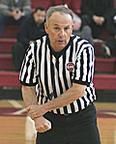


49 Years High School and Junior College Official. Selected 5 times to officiate at the New York State High School Championships
